
In industrial environments, machinery reliability is closely connected to production continuity. A problem affecting one critical machine may disrupt an entire process, particularly when the equipment supports power generation, mechanical drive systems, or essential plant utilities. One maintenance activity used to assess and restore equipment condition is an industrial electrical machine overhaul. Depending on the machine and its condition, an overhaul may involve comprehensive inspection, dismantling, component evaluation, corrective work, reassembly, and testing.
An overhaul is not simply a matter of taking a machine apart, cleaning the components, and putting everything back together. It requires technical planning, coordination among personnel, appropriate tools, safety procedures, and clear criteria for evaluating the completed work.
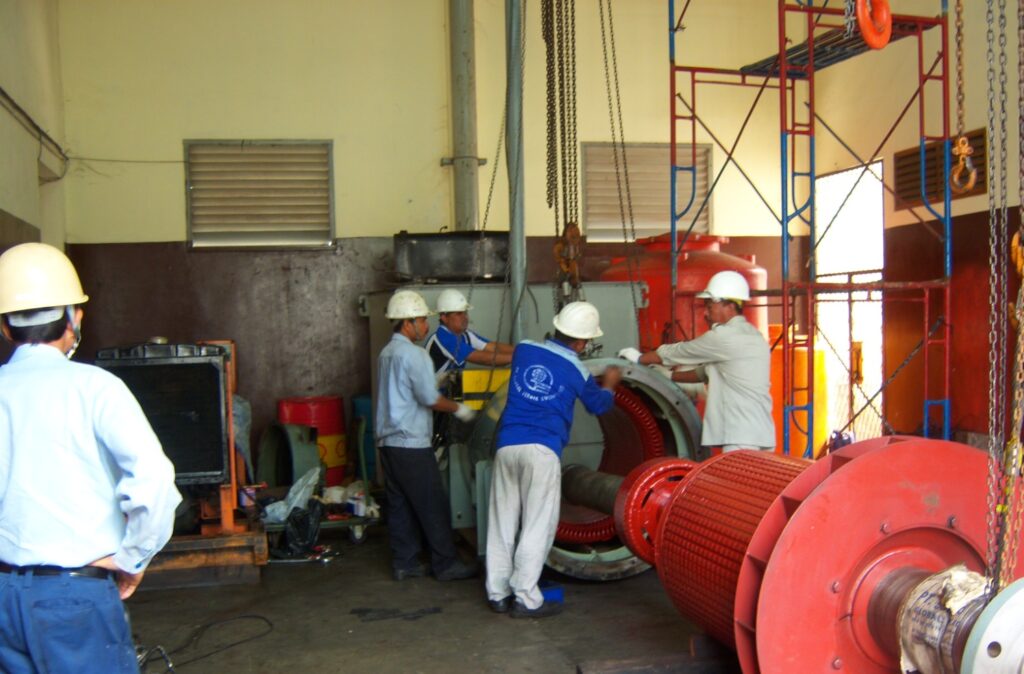
The photographs accompanying this article show technicians working around a large industrial electrical machine. A substantial red component with a cylindrical shaft assembly is positioned using chains and lifting equipment, while other technicians work around the exposed machine assembly. This type of work illustrates several important aspects of industrial maintenance. Heavy components must be handled carefully, mechanical and electrical considerations must be coordinated, and workplace hazards must be controlled throughout the operation.
The weight of a component, its center of gravity, approved lifting points, equipment capacity, and available working space are all important considerations before lifting begins. For companies responsible for industrial facilities, understanding the overhaul process can support better maintenance planning, risk management, and decisions about equipment reliability.
What Is an Industrial Electrical Machine Overhaul?
An overhaul is an extensive maintenance activity intended to assess the condition of equipment and carry out corrective work where necessary. For industrial electrical machines, an overhaul may involve mechanical components, electrical windings, insulation systems, bearings, shafts, cooling systems, and other parts of the machine. The exact scope depends on the equipment design, operating history, inspection findings, and manufacturer’s recommendations.
Equipment that may require overhaul or extensive inspection includes:
- Industrial power generators.
- Large electric motors used to drive pumps and compressors.
- Electrical machines installed in manufacturing facilities.
- Industrial drive equipment used in process operations.
- Machines experiencing abnormal operating conditions or unexpected failures.
Not every machine requires complete dismantling at every maintenance interval. In some cases, routine inspections and condition monitoring provide sufficient information to determine whether more extensive work is necessary. The decision to perform an overhaul should be based on technical evidence and the actual needs of the equipment. The objective is to establish the machine’s condition, identify potential defects, determine the necessary corrective actions, and verify that the work meets the applicable technical requirements.
Why Do Industrial Machines Need an Overhaul?
Industrial machinery can experience gradual changes in condition because of operating loads, temperature, vibration, contamination, moisture, and other environmental or mechanical factors.
A well-planned maintenance program helps identify these changes and determine when further investigation or corrective work is appropriate.
1. Detecting defects that may not be visible externally
Some equipment problems cannot be identified through a simple external inspection. Insulation deterioration, bearing problems, shaft issues, or electrical connection defects may require specialized measurements and additional investigation. An appropriately scoped overhaul can provide access to components that need more detailed examination.
2. Evaluating the actual condition of components
During dismantling and inspection, technicians may identify signs of wear, contamination, mechanical damage, overheating, or other abnormalities. These findings should be documented and assessed against relevant technical criteria. This process helps ensure that maintenance decisions are supported by inspection results rather than assumptions.
3. Supporting maintenance cost planning
A defect that remains unaddressed may contribute to further damage. Although not every failure can be prevented, planned maintenance helps organizations estimate their requirements for spare parts, labor, equipment, and downtime. Inspection findings can also help determine whether a component should be cleaned, repaired, replaced, or monitored. The most appropriate action depends on the severity of the defect, the equipment’s operating requirements, and the applicable acceptance criteria.
4. Reducing the risk of operational disruption
Planned overhaul work allows companies to coordinate equipment shutdowns with production requirements. Maintenance teams can arrange personnel, tools, materials, and testing activities in advance. Coordination between maintenance and operations is particularly important when the equipment supports a critical production process.
5. Investigating unexpected failures
A machine that experiences a significant fault may require a more extensive inspection to establish the underlying cause. The maintenance team should evaluate available operating data, inspection findings, and test results before defining the scope of dismantling and repair. A structured investigation helps avoid unnecessary work and provides a clearer basis for corrective action.
Key Stages of an Industrial Electrical Machine Overhaul
Although the exact workflow varies between machines, a structured overhaul generally involves several major stages.
1. Equipment identification and operating history review
The first step is to collect information about the machine that will be inspected.
Relevant details may include equipment type, model, identification number, technical specifications, operating conditions, maintenance records, and previous failure reports. Technicians should also understand the symptoms reported by operators and the circumstances in which problems occurred. This information helps establish the inspection priorities and select appropriate diagnostic methods.
2. Work planning and risk assessment
Before dismantling begins, the team should define the work sequence, personnel responsibilities, equipment requirements, and methods for handling heavy components. Where lifting operations are involved, a suitable lifting plan is essential. The plan should address load weight, lifting points, rigging configuration, equipment capacity, supporting structures, travel paths, available clearance, and potential hazards. Risk assessment should also consider electrical energy, stored mechanical energy, pinch points, falling objects, and other hazards relevant to the actual work environment. A clear plan helps coordinate the maintenance team and provides a basis for deciding whether the work can proceed safely.
3. Energy isolation and work-area preparation
Before dismantling a machine, relevant energy sources must be isolated according to the applicable safety procedures. This may include lockout/tagout (LOTO), verification of the de-energized condition, securing moving parts, and controlling stored energy. The team must ensure that equipment cannot be unintentionally re-energized while maintenance is in progress. The work area should also be organized to provide safe movement for personnel and equipment. Lighting, access routes, lifting zones, and communication arrangements should be reviewed before work starts. Appropriate personal protective equipment may include safety helmets, safety footwear, suitable gloves, eye protection, and other equipment determined by the identified hazards. Personal protective equipment does not replace energy isolation, engineering controls, or safe work procedures.
4. Systematic machine dismantling
Dismantling should follow the machine’s construction and the relevant technical instructions. Depending on the design, the work may involve removing covers, fasteners, bearings, shaft-related components, or other parts necessary to access the equipment. Technicians should record the positions and orientations of removed components. Photographs, identification labels, and written records can help prevent confusion during reassembly. Parts must be stored in suitable locations to protect them from contamination, impact, moisture, or accidental damage. For large electrical machines, the dismantling sequence should account for the weight and stability of each component as it is released from the assembly.
5. Lifting and handling heavy components
Heavy component handling is one of the most important activities in a major industrial machine overhaul. The photographs used in this article show a large electrical machine component being handled with chains and lifting equipment. Similar activities may be necessary when removing or repositioning heavy assemblies during maintenance. Before lifting, the team must establish the load’s weight using reliable information. If the weight is uncertain, it must be assessed before the lift proceeds. The rated capacity of the lifting equipment and accessories must be checked against the actual load and the planned configuration. The assessment should consider sling or chain angles, load distribution, approved lifting points, and other factors that affect safe working capacity. The center of gravity is another important consideration. An uneven load may tilt, rotate, or shift unexpectedly when lifted, creating hazards for workers and potentially damaging the machine.
The lifting plan should define the lifting path, exclusion zone, communication method, and responsibilities of the personnel involved. Workers must not stand beneath suspended loads. Lifting equipment must not be used beyond its applicable rated capacity, and damaged or unsuitable lifting accessories must not be used. Only competent personnel should conduct or supervise lifting operations in accordance with the approved procedure and the conditions at the worksite.
6. Mechanical and electrical inspection
Once the relevant components are accessible, technicians inspect them according to the agreed work scope. Mechanical inspections may include checking shafts, bearing surfaces, fasteners, clearances, and visible signs of wear or damage. Electrical inspections may include evaluating winding condition, insulation, connections, contamination, and indications of overheating. Additional measurements or specialized testing may be necessary, depending on the equipment and the inspection findings. All significant observations should be documented. Where necessary, the maintenance team can classify findings according to their severity and potential consequences for operation.
Inspection results should be interpreted against the manufacturer’s technical information and relevant acceptance criteria.
7. Corrective work and component replacement
Corrective actions should be selected after the condition of the affected components has been evaluated. Depending on the findings, work may include cleaning, component replacement, mechanical repair, connection repair, or other technically justified activities. A component showing signs of use does not necessarily require immediate replacement. The decision should consider dimensional tolerances, measured condition, operational requirements, and manufacturer guidance. Conversely, a component that does not meet the required acceptance criteria should not be reinstalled simply to shorten the maintenance period. Clear documentation of corrective work supports quality control and future maintenance planning.
8. Reassembly and alignment
After inspection and corrective work, the machine is reassembled according to the required sequence and technical procedures. Component positioning, alignment, fastener tightening, clearances, and other mechanical parameters must be checked as appropriate. Electrical connections and related components must also be restored in accordance with the machine’s technical requirements. Precision is important because an assembly error may create abnormal vibration, mechanical interference, or other problems when the machine returns to operation. The specific installation procedures depend on the equipment design and must follow the relevant technical documentation.
9. Final inspection and functional testing
Completing the reassembly does not automatically mean that an overhaul is finished. Final inspections and tests are necessary to evaluate the quality of the work and determine whether the machine meets the defined acceptance criteria. Depending on the equipment, these activities may include electrical checks, mechanical measurements, alignment verification, and functional testing. The machine should only be returned to service after the required checks have been completed and the relevant personnel have confirmed that the applicable conditions for operation are satisfied. The final report should record completed work, inspection findings, test results, replaced components, and recommendations for future maintenance.
Workplace Safety During Industrial Machine Overhaul
Safety is an integral part of industrial overhaul work. It must be addressed throughout the process rather than treated as a separate activity performed after the technical work is complete. Potential hazards include electrical energy, moving machinery, heavy loads, lifting equipment, hot surfaces, and restricted working spaces. The appropriate controls depend on the equipment, work scope, and conditions at the site.
Important safety principles include:
- Identify hazards and assess risks before work begins.
- Isolate energy sources and verify the required safe condition.
- Use lifting equipment suitable for the actual load and configuration.
- Inspect lifting accessories and remove defective equipment from service.
- Establish clear communication between equipment operators and the maintenance team.
- Restrict access to lifting and other hazardous work zones.
- Stop work if site conditions differ from the approved plan or an unsafe condition develops.
Every worker should understand their responsibilities and the communication procedures used during the operation. If a load shifts unexpectedly, equipment becomes unstable, or an unanticipated hazard appears, the operation should be stopped and reassessed before work continues. These measures help protect workers, prevent equipment damage, and support a more controlled maintenance process.
Equipment Used in Industrial Overhaul Work
Successful overhaul work depends partly on having appropriate tools and equipment available.
Hoists and lifting accessories may be required to move heavy components. Measurement instruments help technicians assess mechanical and electrical conditions. Other specialized tools may be needed for dismantling, alignment, inspection, and reassembly. The required equipment depends on the machine type and the scope of work. A lifting arrangement suitable for one component may not be appropriate for another.
Before work begins, the team should verify equipment suitability, condition, capacity, and any required inspection records. Electrical test instruments must also be suitable for the intended tests and used by competent personnel. Using the wrong tool or an unsuitable lifting arrangement may increase the risk of accidents, damage precision components, and create unnecessary delays. Equipment readiness should therefore be part of the initial work-planning process.
How Overhaul Relates to Generator Rotor and Stator Maintenance
An industrial generator overhaul may include inspecting the rotor and stator, depending on the machine’s condition and the findings of the initial assessment. The rotor is the rotating component, while the stator is the stationary component. Both contribute to the operation of the electrical machine and may require mechanical or electrical inspection. The scope of work may include checking mechanical condition, windings, insulation, electrical connections, and other features relevant to the generator design. For a more detailed discussion of component functions, inspection procedures, and maintenance considerations, read the related article on industrial generator rotor and stator maintenance at Global Tekno.
That article focuses on rotor and stator functions and maintenance, while this article provides a broader overview of the overhaul process, heavy component handling, and workplace safety. Together, the two resources provide complementary information for industrial operators seeking to understand the maintenance of large electrical machines.
Choosing an Industrial Engineering Maintenance Partner
Selecting a suitable maintenance partner requires more than comparing prices. Industrial operators should evaluate whether the service provider has relevant technical competence, appropriate work methods, suitable equipment, and a clear approach to safety. The scope of services should be defined before work begins. This helps establish expectations regarding inspection, dismantling, repairs, replacement parts, testing, and documentation. Companies may also ask prospective service providers to explain their diagnostic methods, lifting arrangements, risk controls, and procedures for evaluating the completed work. Accurate technical documentation and clear communication can help build confidence in the maintenance process.
For PT Global Teknik Engineering, publishing useful technical resources and verified project documentation can help customers understand industrial maintenance requirements and make more informed decisions. Descriptions of specific services, equipment capabilities, certifications, and project experience should always reflect verifiable company information.
Overhaul Planning as Part of Industrial Asset Management
An overhaul should be considered within the broader context of industrial asset management. Equipment maintenance decisions should reflect operating conditions, historical performance, inspection results, failure consequences, and the manufacturer’s recommendations. A structured approach helps organizations determine which machines require closer attention and which maintenance activities should receive priority. Documentation also plays an important role. Inspection reports, measurement records, repair histories, and testing results help maintenance teams track changes in equipment condition over time. This information supports better planning of future inspections, spare-parts requirements, maintenance resources, and shutdown schedules. The objective is not simply to complete an overhaul but to establish a reliable technical basis for managing the equipment throughout its service life.
Industrial electrical machine overhaul is a structured maintenance activity that combines mechanical expertise, electrical knowledge, safety management, and careful work planning. The process may involve equipment identification, risk assessment, energy isolation, dismantling, heavy component handling, inspection, corrective work, reassembly, and final testing. Heavy component lifting requires particular attention to load capacity, center of gravity, approved lifting points, equipment condition, and communication among personnel. Safety controls must remain in place throughout every stage of the operation. By basing maintenance decisions on actual equipment condition and documented inspection results, industrial companies can make more informed decisions about repair requirements, operational risks, and maintenance priorities. PT Global Teknik Engineering can support customer education through accurate industrial engineering content and verified technical documentation that explains maintenance processes, equipment considerations, and safe work practices.